Hi First name,
Thank you for following our progress!
SafeBets is emerging as a growth engine of Unicoin, and so I’m pleased to share with you a recent report about SafeBets.world published in the California Business Journal:
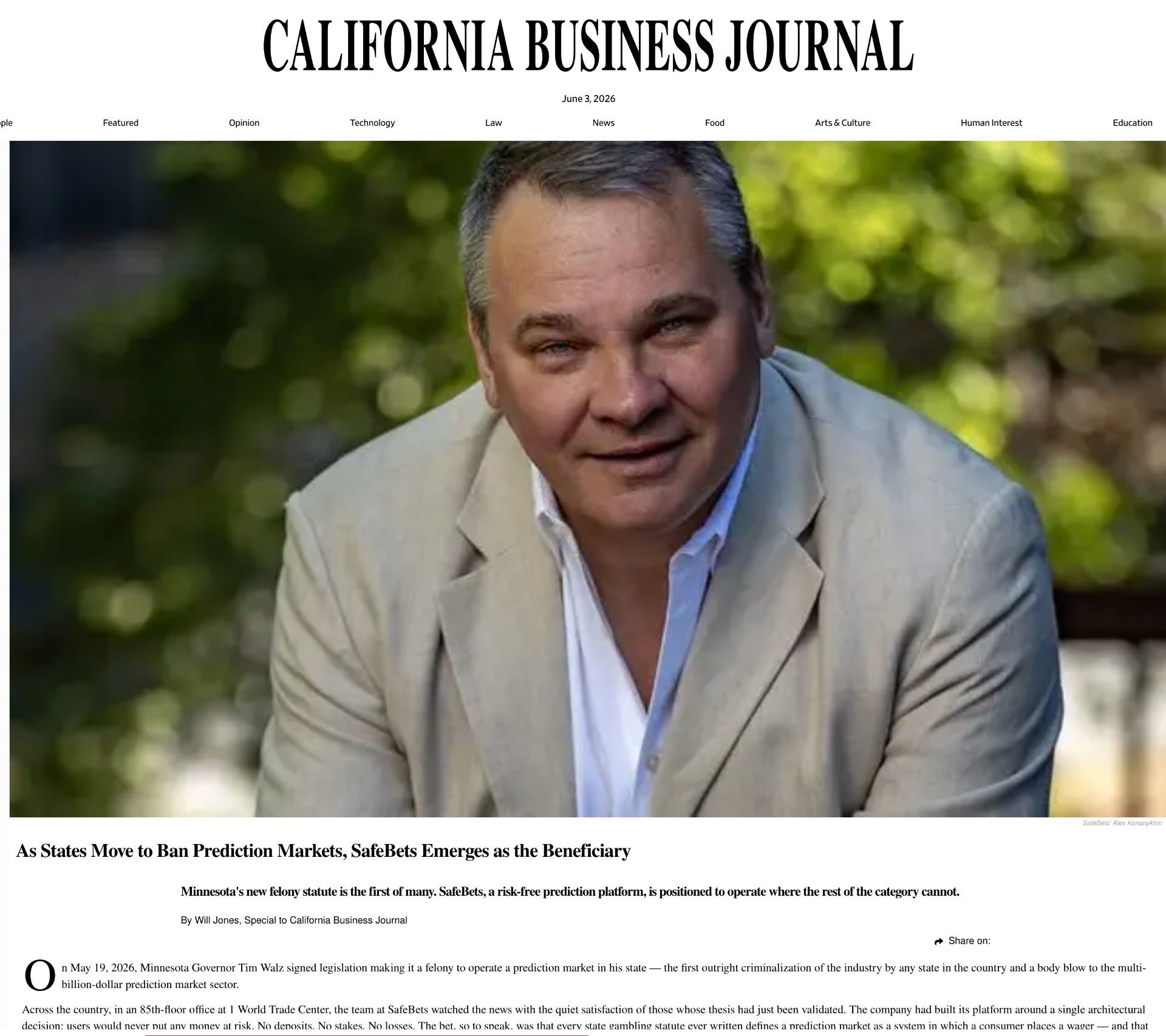
As States Move to Ban Prediction Markets, SafeBets Emerges as the Beneficiary
Minnesota’s new felony statute is the first of many. SafeBets, a risk-free prediction platform, is positioned to operate where the rest of the category cannot.
On May 19, 2026, Minnesota Governor Tim Walz signed legislation making it a felony to operate a prediction market in his state — the first outright criminalization of the industry by any state in the country and a body blow to the multi-billion-dollar prediction market sector.
Across the country, in an 85th-floor office at 1 World Trade Center, the team at SafeBets watched the news with the quiet satisfaction of those whose thesis had just been validated. The company had built its platform around a single architectural decision: users would never put any money at risk. No deposits. No stakes. No losses. The bet, so to speak, was that every state gambling statute ever written defines a prediction market as a system in which a consumer places a wager — and that any future regulation would inherit that definition.
Minnesota’s statute defines it exactly that way. SafeBets users place no wager. The law that just criminalized SafeBets’ competitors does not reach SafeBets.
The architecture is the strategy
The decision to build a risk-free prediction platform was made by Alex Konanykhin, the serial entrepreneur whose ventures also include TransparentBusiness and Unicoin. “The math of a wager-based platform is the math of gambling, regardless of what you call the product,” Konanykhin said. “You can argue about whether sports outcomes are commodities or whether election contracts are speech, and the courts will sort it out eventually. But many states consider prediction markets such as Polymarket and Kalshi as illegal gambling operation. We chose to build a regulations-friendly alternative.”
Here is how it works. SafeBets users sign up, make predictions on a range of events — financial markets, elections, cultural moments, geopolitical outcomes — and accumulate scored results over time. Forecasts that prove correct earn payouts from a prize pool. The unusual part is the source of that pool. Rather than collecting losses from incorrect forecasters and redistributing them to the correct, SafeBets funds payouts from inefficiencies it captures in public financial markets, using its aggregated forecaster signals as inputs to a separate trading operation.
In practice, the platform treats its users as a distributed research desk. The more calibrated a forecaster proves to be across thousands of questions, the more his signal shapes the trading operation, and the larger his share of the prize pool.
“The user gets paid for being right,” Konanykhin said. “That is our entire pitch. Everything else — the trading desk, the calibration math, the regulatory position — is what we do so that we can deliver on that promise.”
“We did not navigate the regulatory wall. We went around it entirely.”
— Gina Antoniello, Chairwoman of the Board, SafeBets
Emerging from the noise
Until this week, SafeBets was operating under the radar of mainstream financial coverage, which has been dominated by Kalshi’s and Polymarket’s rapid ascent to multi-billion-dollar valuations and their increasingly visible political alignments. Both companies have powerful federal cover: the CFTC chairman has publicly framed state regulators as adversaries of innovation, and Donald Trump Jr. advises both firms.
That visibility is also why the Minnesota signing was so consequential. The state did not just pass a narrow restriction. It defined an entire business model as criminal — by bipartisan vote, in a public-safety bill, in a state with no online gambling and no legal sports betting. The political ground beneath the wager-based prediction industry has shifted, and SafeBets, with its alternative architecture, is suddenly the most interesting name in a category that until now belonged to Polymarket and Kalshi.
Industry observers have begun to take notice. “The Minnesota law forces a question the industry has been avoiding,” said one fintech analyst who has been tracking the category. “What does a prediction market look like that is not a gambling product? Until this week, you could argue there was no commercial answer to that question. There is now.”
What it means for the category
The CFTC’s challenge to Minnesota may succeed. It may not. A federal judge in Nevada has already found Kalshi’s sports contracts “indistinguishable” from state-regulated sports betting, and courts elsewhere have split on similar questions. Seven additional states have prediction-market bills moving through their legislatures. Even an industry that ultimately prevails on federal preemption will spend the next several years and considerable capital defending itself in court, state by state.
That cost — measured in legal fees, executive attention, market access, and investor confidence — is the gap SafeBets is built to fill. The company does not need any state to permit a wager-based prediction market because it does not run one. It does not need the CFTC to win, because the CFTC’s case is not its case. The strategic question for the industry, in other words, is no longer whether prediction markets will survive the current wave of regulation. It is what version of prediction markets will.
SafeBets’ answer is one that does not depend on the outcome.
What comes next
The company is currently raising capital from accredited investors, with proceeds earmarked for product expansion, forecaster acquisition, and the trading operation that funds the prize pool.
On the product side, the roadmap includes expanded question categories and adding sports predictions functionality.
“We must move fast to convert our regulatory advantage into making SafeBets the leading prediction platform,” Konanykhin said. “But this week has been clarifying. The category needed an alternative. We are it.”
Copyright © 2026 California Business Journal. All Rights Reserved.
With very best wishes,
Alex Konanykhin, CEO
SafeBets.world Inc. and
TransparentBusiness Inc.
Linkedin.com/in/konanykhin
Konanykhin.com
SafeBets.world Inc. and
TransparentBusiness Inc.
Linkedin.com/in/konanykhin
Konanykhin.com
1 World Trade Center, 85th Floor
New York, NY 10007
New York, NY 10007
——————————————-
IMPORTANT:
My updates represent my personal opinions.
My updates are not intended to serve as financial advice or to replace our official reports filed with the SEC.
Please note that I cannot possibly answer all the questions myself, so your response to this message may be processed by members of our Investor Relations team.
Success is never guaranteed. Risks are a factor in every business.
TransparentBusiness Inc. will not be providing “essential managerial efforts,” its shareholders voted to transfer those to Unicoin Foundation, which is currently being incorporated.
For a period of time, TransparentBusiness Inc. operated under the name Unicoin Inc. We reverted to our company’s original name in April of 2026.
SafeBets.world. is operated by Foresight Collective, Inc., a Delaware corporation founded by me.
Copyright © 2026 TransparentBusiness, Inc., All rights reserved.
Our mailing address is:
228 Park Ave South, #16065, New York, NY 10003, USA
Our mailing address is:
228 Park Ave South, #16065, New York, NY 10003, USA
You received this email because you subscribed to our list.
You can unsubscribe at any time.