Hi First name,
Thank you for following our progress!
I’m excited to share with you a new report about our SafeBets.world:
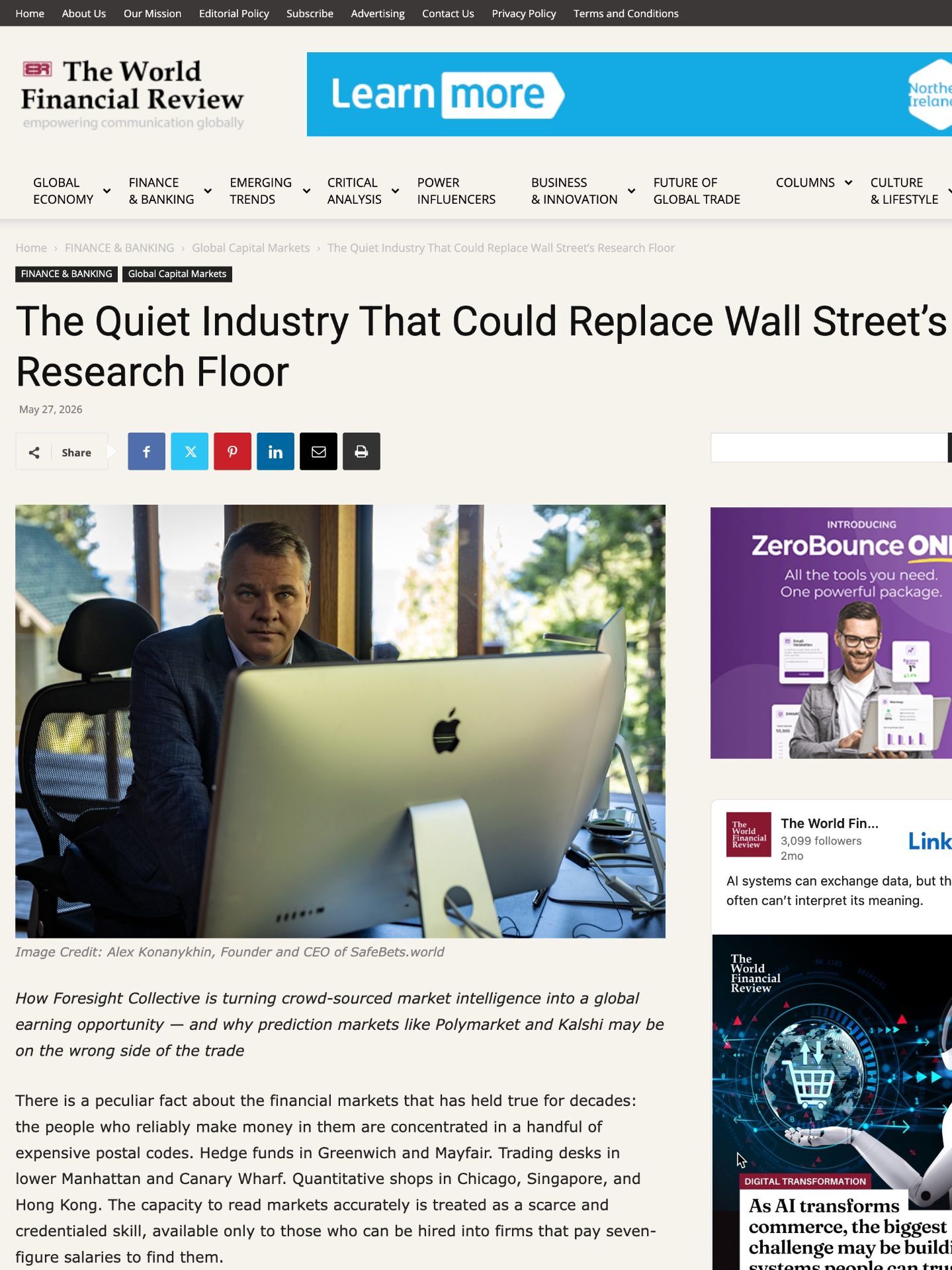
Foresight Collective, Inc., a New York-based company that launched its SafeBets platform on April 23, 2026, is built on a contrarian thesis: the talent is not scarce. The infrastructure to find it and deploy it productively has simply not existed before.
A different kind of prediction platform
The platform looks superficially similar to prediction markets like Polymarket and Kalshi, which have collectively attracted billions of dollars in trading volume by allowing users to bet on the outcomes of real-world events. The user experience involves opening an account, depositing money, and placing wagers on which outcomes will occur.
That model is now under sustained regulatory pressure. In May 2026, Minnesota became the first state to criminalize the operation of prediction markets, making it a felony to run such a platform within its borders. The federal Commodity Futures Trading Commission immediately sued to block the law, but the political signal was unmistakable. The reason is that prediction markets, by the legal definition every U.S. state uses, are gambling: users place wagers on uncertain outcomes, and most lose money over time.
The SafeBets platform is built around a single architectural decision that distinguishes it categorically from these competitors: users place no wager.
No deposit. No stake. No capital at risk of loss. Participants make predictions on cryptocurrency prices, commodity movements, equities, foreign exchange, and other tradable markets, but their own money never moves. The Minnesota statute, which defines a prediction market as “any system that allows consumers to place a wager,” does not reach SafeBets. The same is true of essentially every state gambling law on the books.
The economic model is what makes the structure work. SafeBets does not generate revenue from user losses, because there are no user losses. Instead, the platform aggregates the predictions of its top performers into a real-time intelligence signal, which Foresight Collective’s affiliated trading entities deploy into actual financial markets — crypto exchanges, commodity futures, equity indices, FX pairs. The trading profits become the source of prize pools awarded to the most accurate forecasters.
In effect, Foresight Collective is operating a hedge fund whose research desk consists of thousands of independent forecasters, each compensated for being right.
The model prediction markets cannot replicate
A prediction market makes money in two ways: by taking a fee on each transaction, or by holding the float and benefiting from users who lose money to those who win. In either case, the underlying value created is the betting activity itself. The prediction data is a byproduct, not the product.
Foresight Collective inverts this. The predictions are the product. The platform exists to identify accurate forecasters, aggregate their intelligence, and deploy it into markets where being right has direct monetary value. The user experience is a contest for skilled participants, not a casino for speculative bettors. The economic engine is trading returns generated against external counterparties, not transaction fees extracted from a closed user base.
A platform whose business model depends on users losing money to other users has a structural limit: it can only grow as fast as it can attract new losing participants. A platform whose business model depends on aggregating skilled predictions has a different scaling curve entirely. More participants mean more signal. Better signal means better trading returns. Better returns mean larger prize pools. Larger prize pools attract more skilled participants. The flywheel runs on accuracy, not on churn.
A new earning opportunity for a global pool of analysts
The most consequential implication of the model is not its competitive position against existing prediction markets. It is the opportunity it creates for a class of workers who have never before had direct access to financial markets as a source of income: skilled forecasters located anywhere in the world, including in regions where local economies offer few professional opportunities.
To be paid for understanding markets today, you generally need to be hired by a financial firm, which generally means living in or near one of perhaps a dozen global financial centers. The university degree, the regulatory licensing, the personal network, the visa status, the rent in Manhattan or London — every step of the pipeline is structured around physical and credential gatekeeping that excludes the vast majority of people who might be genuinely skilled at the work.
The SafeBets platform removes this gatekeeping entirely. To participate, a forecaster needs an internet connection and a track record of accuracy. The platform ranks participants by their actual predictive performance over time, not by their resume or location. A 25-year-old in Lagos with insight into African commodity markets can build a verifiable track record. A retired analyst in Manila with three decades of regional currency experience can compete on equal terms with a Stanford MBA in Palo Alto. The platform pays the same dollar amount for the same accuracy, regardless of where the forecaster lives.
The Uber and Airbnb parallel
The closest analogies for the economic dislocation this could produce are Uber and Airbnb, both of which created earning opportunities for people whose previous options were considerably narrower.
Before Uber, a person who owned a car and had time to drive had no straightforward way to convert that into income. Uber’s contribution was not the car or the driving — both already existed — but the infrastructure that connected supply to demand at scale. Today, millions earn meaningful income through Uber and similar platforms worldwide, with the highest impact concentrated in markets where alternative employment is scarce.
Before Airbnb, a person who owned a spare room had no marketplace to monetize it. Airbnb’s contribution was the infrastructure that turned latent housing capacity into income, with particular impact in regions where tourism is the primary economic activity.
The Foresight Collective model points toward the same kind of unlock, applied to financial analysis. The latent supply — skilled forecasters whose insights have never had a marketplace — already exists. What has been missing is the infrastructure to identify them, verify their accuracy, and pay them for being right.
A forecaster in Vietnam may have insights into regional supply chains that no Manhattan analyst can match. A forecaster in Nigeria may understand local energy markets in ways that no London commodities desk could replicate. A forecaster in Argentina may have lived experience of currency instability that no Chicago quant could acquire from data alone. The platform’s structure rewards exactly this kind of distributed, local expertise — and pays for it in real money.
What this could become
The history of internet platforms suggests the most consequential ones are not necessarily those that look most disruptive at launch. Uber initially looked like a slightly better taxi app. Airbnb initially looked like a slightly better classified ad. The transformative effect — the creation of entirely new categories of work — became apparent only as the platforms matured and network effects compounded.
The SafeBets platform launched on April 23 with similar surface modesty. But the underlying architecture — separation of forecaster compensation from user wagering, monetization through external market trading rather than internal user losses, global open access without credential gatekeeping — points toward something more substantial: the early infrastructure of a decentralized industry of market analysts, distributed across the world, compensated directly for the value of their insights.
The capacity to read markets — historically one of the most credentialed and geographically concentrated skills in the modern economy — would become accessible as a source of income to anyone with internet access and the discipline to develop genuine accuracy over time. The prediction markets that came before it monetize losers. The platform Foresight Collective is building monetizes accuracy — and pays for it globally.
With very best wishes,
Alex
——————————————-
Alex Konanykhin, CEO
SafeBets.world Inc. and
TransparentBusiness Inc.
Linkedin.com/in/konanykhin
Konanykhin.com
Alex Konanykhin, CEO
SafeBets.world Inc. and
TransparentBusiness Inc.
Linkedin.com/in/konanykhin
Konanykhin.com
1 World Trade Center, 85th Floor
New York, NY 10007
New York, NY 10007
——————————————-
IMPORTANT:
My updates represent my personal opinions.
My updates are not intended to serve as financial advice or to replace our official reports filed with the SEC.
Please note that I cannot possibly answer all the questions myself, so your response to this message may be processed by members of our Investor Relations team.
Success is never guaranteed. Risks are a factor in every business.
TransparentBusiness Inc. will not be providing “essential managerial efforts,” its shareholders voted to transfer those to Unicoin Foundation, which is currently being incorporated.
For a period of time, TransparentBusiness Inc. operated under the name Unicoin Inc. We reverted to our company’s original name in April of 2026.
SafeBets.world. is operated by Foresight Collective, Inc., a Delaware corporation founded by me.
Copyright © 2026 TransparentBusiness, Inc., All rights reserved.
Our mailing address is:
228 Park Ave South, #16065, New York, NY 10003, USA
Our mailing address is:
228 Park Ave South, #16065, New York, NY 10003, USA
You received this email because you subscribed to our list.
You can unsubscribe at any time.